Skip to content
Fast & Discrete Delivery Save up to 80%
In stock Clomid
Infertility

Clomid

Ovulatory dysfunction can make conception difficult when ovulation is absent or irregular. Clomid is used for ovulatory problems and stimulates pituitary hormones that help the ovaries release an egg.

Guaranteed quality Original product
Delivery: from 4 days Discreet shipping
24/7 Support Always available
Active ingredient: Clomifene
Select dosage:
Select pack Package Per unit Price
AED 22.29 AED 222.88
AED 15.32 AED 445.76 AED 306.46 Save 31%
AED 11.41 AED 668.64 AED 342.28 Save 49%
AED 6.63 AED 1,337.28 AED 398.00 Save 70%
AED 4.91 AED 2,005.92 AED 441.78 Save 78%
AED 4.34 AED 2,674.56 AED 521.38 Save 81%
AED 3.32 AED 4,011.84 AED 597.00 Save 85%
Free Regular Delivery AED 3.10 AED 6,017.76 AED 835.80 Save 86%
Best value Free Regular Delivery AED 2.82 AED 8,023.68 AED 1,014.90 Save 87%
AED 11.14 AED 222.88
AED 8.76 AED 334.32 AED 262.68 Save 21%
AED 5.31 AED 668.64 AED 318.40 Save 52%
AED 3.98 AED 1,002.96 AED 358.20 Save 64%
AED 3.32 AED 1,337.28 AED 398.00 Save 70%
AED 2.56 AED 2,005.92 AED 461.68 Save 77%
AED 1.93 AED 3,008.88 AED 521.38 Save 83%
Best value AED 1.72 AED 4,011.84 AED 620.88 Save 85%
AED 18.31 AED 183.08
AED 13.13 AED 366.16 AED 262.68 Save 28%
AED 10.08 AED 549.24 AED 302.48 Save 45%
AED 6.04 AED 1,098.48 AED 362.18 Save 67%
AED 4.42 AED 1,647.72 AED 398.00 Save 76%
AED 3.52 AED 2,196.96 AED 421.88 Save 81%
AED 2.90 AED 3,295.44 AED 521.38 Save 84%
AED 2.59 AED 4,943.16 AED 700.48 Save 86%
Best value Free Regular Delivery AED 2.39 AED 6,590.88 AED 859.68 Save 87%

Free delivery on orders from AED 796.00, free express delivery from AED 1,194.00

Secure payment methods:
VISA AMEX JCB DISCOVER

Ovulatory dysfunction can make conception difficult when ovulation is absent or irregular. Clomid is used for ovulatory problems and stimulates pituitary hormones that help the ovaries release an egg.

Overview

Clomid contains clomiphene citrate and is used in fertility treatment for ovulatory dysfunction. It stimulates pituitary hormones that help the ovaries release an egg.

Active ingredient and formulation

Clomid is supplied as tablets containing clomiphene citrate. The amount taken at each intake is set individually for each person rather than being one fixed amount.

Clomiphene citrate is used for a specific ovulatory problem and is not a general fertility tonic.

What it is used for

Clomid is used for infertility caused by irregular or absent ovulation when the ovaries can respond to stimulation. Common clinical situations include ovulatory dysfunction associated with polycystic ovary syndrome, provided other causes of infertility have been assessed.

A fertility clinician may consider clomiphene after reviewing:

  • Menstrual-cycle pattern and evidence of ovulation
  • Pregnancy status
  • Ovarian reserve and pelvic anatomy
  • Thyroid and prolactin results
  • Semen analysis for the male partner
  • Fallopian-tube patency when clinically indicated
  • Previous response to fertility treatment

Clomid may also be used within selected assisted-reproduction protocols. The choice depends on the fertility diagnosis, age, ovarian reserve, sperm findings, and the risk of multiple pregnancy. The World Health Organization places ovulation induction within a broader infertility-care pathway that begins with assessment of both partners and the underlying cause [2]. Guidance from NICE and the European Society of Human Reproduction and Embryology also supports assessment of the underlying infertility diagnosis before treatment.

Clomiphene is not appropriate when infertility results from blocked fallopian tubes, severe male-factor infertility, or ovarian failure unless a fertility specialist identifies a specific role for it. Treating anovulation alone cannot correct every cause of difficulty conceiving.

Formulation

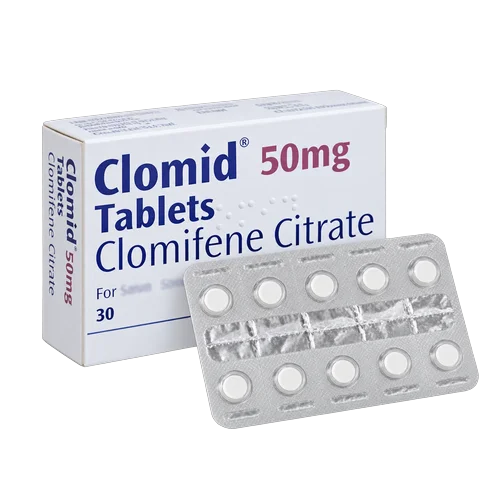
Clomid is an oral fertility medicine containing clomiphene citrate. The product is supplied as tablets. Clomiphene is used for ovulatory problems and stimulates pituitary hormones that help the ovaries release an egg.

The medicine is prescribed mainly for women with anovulation or irregular ovulation. Treatment requires a clinician to assess the cause of infertility before starting therapy.

Mechanism of action

The reproductive hormone system uses feedback signals. Rising estrogen normally tells the hypothalamus and pituitary gland that ovarian activity is progressing. Clomiphene citrate temporarily interferes with estrogen feedback at the hypothalamus.

That change makes the brain respond as though estrogen activity is lower than it is. The hypothalamus increases release of gonadotropin-releasing hormone, or GnRH. The pituitary gland then releases more follicle-stimulating hormone, or FSH, and luteinizing hormone, or LH.

FSH supports follicle growth in the ovary. LH contributes to the final maturation of the dominant follicle and the ovulatory surge. When the response is adequate, ovulation may occur after the treatment course.

Clomid therefore works through the hypothalamic-pituitary-ovarian axis. It does not directly supply estrogen, FSH, or LH. Its action depends on functioning ovarian tissue and an endocrine system capable of responding to stimulation.

The FDA prescribing information describes clomiphene as an ovulatory stimulant that acts through hypothalamic-pituitary signalling [1]. This mechanism differs from injectable gonadotropin treatment, which supplies FSH or LH activity directly and carries a different monitoring burden.

How to use it

The amount per intake is determined individually for each person rather than being one fixed amount. A fertility clinician selects the treatment schedule after assessing the menstrual-cycle pattern, evidence of ovulation, pregnancy status, ovarian reserve, pelvic anatomy, thyroid and prolactin results, and other relevant fertility factors.

The exact treatment plan can include:

  • Review of the menstrual-cycle pattern and evidence of ovulation
  • Assessment of pregnancy status before treatment
  • Evaluation of ovarian reserve and pelvic anatomy
  • Thyroid and prolactin testing
  • Semen analysis for the male partner
  • Assessment of fallopian-tube patency when clinically indicated
  • Review of any previous response to fertility treatment

Do not begin another course without guidance from the fertility clinician. The clinician determines whether treatment should be repeated or changed after reviewing the response and relevant fertility findings.

Clomid should be used according to the treatment plan selected by the fertility clinician.

Comparison

Clomid is one approach to ovulation induction. Other approaches use different hormone pathways or different treatment goals.

Approach Main action Typical clinical role
Clomiphene citrate Reduces estrogen feedback at the hypothalamus and increases FSH and LH signalling Oral ovulation induction
Letrozole Temporarily reduces estrogen production, increasing pituitary stimulation Oral ovulation induction, often considered in polycystic ovary syndrome
Injectable gonadotropins Provides direct FSH or LH activity More intensive stimulation with ultrasound monitoring

Letrozole may be preferred in some patients with polycystic ovary syndrome because studies have shown favourable ovulation and live-birth outcomes in selected groups. Clomiphene remains useful when its risk profile, prior response, availability, or clinical history makes it a suitable option.

Injectable gonadotropins require closer monitoring and can produce several developing follicles. That may raise the risk of ovarian hyperstimulation and multiple pregnancy. The choice is a clinical decision rather than a simple strength comparison.

Common mistakes

  • Starting tablets on the wrong cycle day
  • Taking an extra tablet after a missed dose
  • Repeating a course without pregnancy testing
  • Continuing treatment despite new visual symptoms
  • Assuming a positive ovulation test proves that conception will occur
  • Ignoring severe abdominal swelling or breathlessness
  • Using additional fertility hormones without a coordinated plan
  • Treating irregular bleeding as proof that ovulation occurred
  • Failing to attend ultrasound or blood-test monitoring
  • Stopping follow-up after one unsuccessful cycle

A frequent misunderstanding is that a stronger dose automatically produces a better result. Excessive ovarian stimulation can increase risk without improving the chance of a healthy pregnancy.

Another practical issue is timing intercourse only once. Fertility clinics commonly discuss a fertile window because ovulation timing can vary even when the treatment cycle is planned.

Do not use leftover tablets from an earlier cycle for a later month. A new cycle may require pregnancy exclusion, a pelvic review, or a different treatment plan.

Who should not use it

  • Known or suspected pregnancy
  • Active or previous significant liver disease linked to treatment concerns
  • Unexplained abnormal uterine bleeding
  • Uncontrolled thyroid disease
  • Uncontrolled adrenal disease
  • Ovarian cysts unrelated to polycystic ovary syndrome
  • Allergy to clomiphene citrate or an excipient
  • Ovarian failure where stimulation is unlikely to produce a response

When this is not for you

This medication is not for you if pregnancy is present, if you have significant liver disease, or if you have unexplained uterine bleeding. It is also unsuitable when an ovarian cyst is present for a reason unrelated to polycystic ovary syndrome, unless a specialist has assessed the finding and selected a different plan.

A pelvic examination and appropriate fertility assessment help identify conditions that could make stimulation unsuitable. The cause of infertility should be evaluated before treatment rather than inferred from irregular bleeding alone.

Clomiphene is not intended for long-term ovulation suppression or repeated unsupervised courses. The medicine should also be stopped if pregnancy occurs.

Unwanted effects

Clomiphene can produce effects linked to changing ovarian and hormonal activity. Common effects include hot flushes, headache, breast discomfort, nausea, mood changes, abdominal discomfort, and ovarian enlargement.

Some effects are temporary and resolve after the course ends. Others require assessment because they may indicate excessive ovarian response or a rare complication.

Common effects

Possible reactions include:

  • Hot flushes or sweating
  • Headache or light-headedness
  • Nausea, vomiting, or abdominal discomfort
  • Breast tenderness
  • Mood changes, irritability, or sleep disturbance
  • Bloating or pelvic pressure
  • Ovarian enlargement or functional ovarian cysts

Visual symptoms deserve special attention. Blurred vision, flashing lights, floaters, spots, or difficulty focusing can occur and may persist or worsen with continued exposure. Clomiphene treatment should be stopped and urgently reviewed if sudden or significant visual changes develop.

Serious risks

Ovarian hyperstimulation syndrome can cause marked abdominal swelling, severe pelvic pain, rapid weight increase, vomiting, breathlessness, or reduced urine output. The condition can become medically serious and requires prompt assessment.

Multiple pregnancy is another treatment-related risk. Stimulation of more than one follicle can increase the chance of twins or higher-order pregnancy. The FDA label identifies visual disturbance, ovarian enlargement, and ovarian hyperstimulation among clinically relevant risks .

A small amount of pelvic fullness can occur during follicle growth. Severe pain, one-sided pain, faintness, breathlessness, or rapid abdominal swelling needs urgent medical assessment rather than home monitoring.

What doctors say

In clinical practice, fertility doctors usually focus first on whether ovulation is the actual problem. Irregular cycles alone do not prove that clomiphene is the right treatment. A patient may also have tubal, uterine, thyroid, prolactin, ovarian-reserve, or sperm-related factors that need attention.

A doctor would normally explain that Clomid can induce ovulation without guaranteeing conception. Pregnancy depends on egg and sperm factors, tubal function, timing, embryo development, and uterine conditions.

Treatment response is often assessed after the first course. If ovulation does not occur, the clinician may adjust the regimen or choose another approach. Repeating the same course without evaluation can delay more suitable treatment.

Patients with polycystic ovary syndrome may respond differently from those with hypothalamic amenorrhoea or reduced ovarian reserve. The underlying endocrine pattern matters.

What customers often ask

What happens after stopping Clomid, and does it need tapering?

Clomid is generally administered in a short, defined course rather than as a medicine that requires gradual dose reduction. The pituitary and ovarian effects usually change after the treatment window ends, while ovulation may occur later in that cycle. The FDA prescribing information from 2012 describes short-course ovulation induction rather than a tapering schedule. A new course should only begin after the fertility clinician reviews the cycle and excludes pregnancy. Follow-up timing should be confirmed before another treatment cycle.

How long does one Clomid dose keep working?

A single dose contributes to the hormonal effect of the five-day treatment course, rather than acting like a one-time ovulation injection. Clomiphene and its metabolites can remain in the body for an extended period, and the clinical effect may extend beyond the final tablet. The FDA product information from 2012 describes persistence of clomiphene-related compounds after treatment. The timing of ovulation still varies, so intercourse or insemination timing should follow the clinic’s plan.

Which symptoms mean stopping Clomid and seeking urgent medical care?

Sudden visual changes, severe pelvic or abdominal pain, rapid abdominal swelling, breathlessness, fainting, heavy bleeding, or markedly reduced urination require urgent medical assessment. These symptoms may indicate a serious ocular or ovarian complication. The EMA’s 2018 product-information framework identifies visual disturbance and ovarian complications as reasons for prompt clinical review. Do not take another dose while waiting for assessment after a significant visual symptom.

Can diet, exercise, or daily habits improve the result?

Balanced nutrition, regular moderate activity, adequate sleep, and avoidance of tobacco support general reproductive health, though they cannot replace ovulation treatment. Excessive exercise, rapid weight loss, and severe calorie restriction can disrupt reproductive hormone signalling. The WHO infertility guidance published in 2023 supports assessment of modifiable health factors alongside medical treatment. No food has been shown to make clomiphene work reliably or to compensate for an unsuitable treatment plan.

Can alcohol be used while taking Clomid?

Alcohol is not known to create a single predictable interaction with clomiphene, but it can worsen dizziness, headache, nausea, sleep disturbance, or impaired judgement. Alcohol can also interfere with pregnancy planning and may be unsuitable when liver disease is present. The FDA prescribing information from 2012 identifies liver disease as a major selection concern for clomiphene treatment. Avoid alcohol if it worsens symptoms or if the treating clinician has advised abstinence.

Do you offer anonymous delivery?

Your order will be securely packed and shipped within 24 hours. This is exactly what your package will look like (images of an actual item sent). It has the size and look of a regular private letter (24x11x0.7 cm) and its contents cannot be seen.

Customer Feedback on Clomid

Based on 4 reviews

Mona, 65 Verified
Rating: 3 out of 5

The clinic gave me clear cycle-day instructions, and ultrasound showed a growing follicle. I had hot flushes and felt more emotional for several days, but the main difficulty was keeping track of appointments.

Mirdif Five days 27 Oct 2026
Layla, 50 Verified
Rating: 3 out of 5

The first cycle did not produce ovulation, so the fertility doctor changed the plan rather than telling me to repeat it alone. I experienced headaches and bloating, and the second monitoring visit made the process feel more manageable.

Al Ain Individually adjusted course 30 Sep 2026
Shamma G., 41 Verified
Rating: 2 out of 5

I noticed blurred vision while reading in the evening. The clinic told me to stop treatment and attend an urgent review. The symptom improved, but I would not have ignored it after learning that visual changes can be significant.

Al Barsha One monitored cycle 16 Oct 2026
Lina, 66 Verified
Rating: 3 out of 5

The treatment helped produce ovulation, but pregnancy did not happen in that cycle. My doctor explained that ovulation is only one part of fertility, which made the result easier to understand.

Al Reem Island Five-day course 5 Oct 2026

Sources

  1. U.S. Food and Drug Administration (2012). Clomid (clomiphene citrate) tablets: Prescribing Information.
  2. World Health Organization (2023). Guideline for the Prevention, Diagnosis and Treatment of Infertility.
Get our free app Shop faster and track your orders 3.4 · 316 reviews Install