The small inflamed bumps became less frequent after the first month. My cheeks felt dry during the opening weeks, so I stopped using my exfoliating cleanser and the cream became easier to tolerate.
Ras Al Khaimah Several weeks 26 Oct 2026
Soolantra
Soolantra is a topical cream applied to facial skin for inflammatory lesions of papulopustular rosacea. It contains ivermectin and is supplied in a 45 g tube. The cream helps reduce inflammation and…
Soolantra is a topical cream applied to facial skin for inflammatory lesions of papulopustular rosacea. It contains ivermectin and is supplied in a 45 g tube. The cream helps reduce inflammation and the activity of Demodex mites associated with rosacea.
Overview
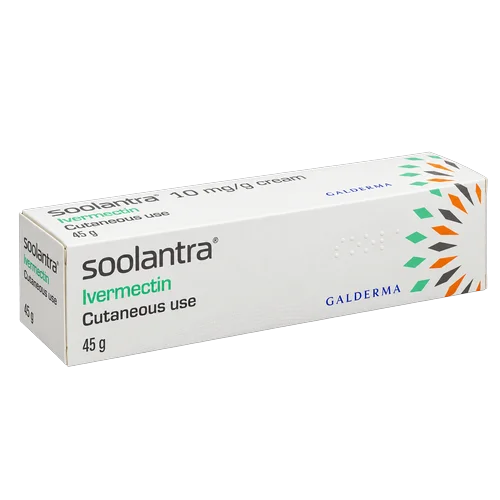
Soolantra contains ivermectin as its active pharmaceutical ingredient. It belongs to the dermatological treatment category and is formulated as a cream for cutaneous use. The product information identifies Galderma on the pack markings, and the supplied tube contains 45 g of cream.
Ivermectin has antiparasitic and anti-inflammatory properties. In rosacea, the topical formulation is applied to affected facial areas rather than taken by mouth. The treatment is intended for inflammatory lesions such as papules and pustules associated with rosacea.
Active ingredient and pharmaceutical form
The key product facts are:
- Product name: Soolantra
- Active ingredient: Ivermectin
- Dosage form: Topical cream
- Route: Cutaneous application
- Pack size: 45 g tube
- Therapeutic area: Inflammatory papulopustular rosacea
- Manufacturer marking: Galderma
The exact regimen for the selected strength should be confirmed with a healthcare professional before starting. Soolantra is applied to facial skin, not swallowed, injected, or used as a general moisturiser.
The FDA prescribing information describes ivermectin cream as a topical treatment for inflammatory lesions of rosacea [1].
What it is used for
Soolantra is a topical cream applied to facial skin for inflammatory lesions of papulopustular rosacea.
The treatment is intended for inflammatory lesions such as papules and pustules associated with rosacea.
Soolantra belongs to topical dermatological treatments for inflammatory rosacea. It is aimed at inflammatory papules and pustules associated with rosacea.
Formulation
Soolantra contains ivermectin as its active pharmaceutical ingredient. It belongs to the dermatological treatment category and is formulated as a cream for cutaneous use. The product information identifies Galderma on the pack markings, and the supplied tube contains 45 g of cream.
Ivermectin has antiparasitic and anti-inflammatory properties. In rosacea, the topical formulation is applied to affected facial areas rather than taken by mouth. The treatment is intended for inflammatory lesions such as papules and pustules associated with rosacea.
Active ingredient and pharmaceutical form
The key product facts are:
- Product name: Soolantra
- Active ingredient: Ivermectin
- Dosage form: Topical cream
- Route: Cutaneous application
- Pack size: 45 g tube
- Therapeutic area: Inflammatory papulopustular rosacea
- Manufacturer marking: Galderma
Mechanism of action
Rosacea involves persistent inflammation around facial blood vessels, hair follicles, and oil-producing skin structures. Papules and pustules can develop when inflammatory pathways become overactive. Demodex mites may also contribute to inflammation in some patients.
Ivermectin works through two clinically relevant actions:
- It has antiparasitic activity against Demodex mites.
- It reduces inflammatory signalling in the skin.
The result is a gradual reduction in inflammatory lesions rather than an instant change in redness. This distinction matters because papules and pustules often improve before diffuse facial flushing or visible blood vessels.
The Cochrane review of rosacea treatments found that topical therapies can reduce inflammatory lesion counts, though individual responses vary and recurrence may occur after treatment stops [2].
How to use it
The prescribed regimen for the chosen strength must be confirmed with a healthcare professional before starting. Soolantra is applied to the face as a thin layer over the areas affected by rosacea.
Use these practical steps:
- Cleanse the face with a mild, non-abrasive cleanser.
- Pat the skin dry without rubbing.
- Apply a thin, even layer of Soolantra to the affected facial areas.
- Avoid the eyes, eyelids, lips, inside of the nose, and other mucous membranes.
- Wash the hands after application unless the hands are part of the treated area.
- Allow the cream to absorb before applying other facial products.
- Use the cream at the frequency selected by the prescriber.
Do not apply extra cream to compensate for a missed application. Resume the prescribed schedule at the next appropriate time. Applying a thicker layer does not produce faster improvement and may increase irritation.
The face should be treated as several connected areas: forehead, nose, chin, and both cheeks. Avoid applying a large amount only to the most visible spot while leaving nearby inflammatory lesions untreated.
Soolantra should not be used on broken, infected, or severely irritated skin unless the treating clinician has specifically included those areas in the plan. Contact with the eyes or mucous membranes requires rinsing with plenty of water.
Comparison
The most useful comparison is based on active substance and mechanism rather than brand name.
| Treatment approach | Main action | Practical distinction |
|---|---|---|
| Ivermectin cream | Antiparasitic and anti-inflammatory | Suited to inflammatory rosacea with possible Demodex involvement |
| Metronidazole topical treatment | Anti-inflammatory and antimicrobial | Common option for inflammatory lesions and redness |
| Azelaic acid topical treatment | Anti-inflammatory and keratinisation-modifying | May help lesions and uneven post-inflammatory colour |
Ivermectin may be selected when papules and pustules are prominent or when Demodex involvement is considered clinically relevant. Metronidazole may be preferred when a patient has previously tolerated it well. Azelaic acid can be useful when inflammatory lesions occur alongside uneven pigmentation, though stinging is common during early use.
These treatments are not automatically interchangeable. Combining topical agents without a defined plan can increase dryness, burning, and peeling. The clinician may choose one treatment first, then adjust the regimen according to lesion response and tolerability.
Common mistakes
Several usage errors can reduce tolerability or make the treatment seem ineffective:
- Applying a heavy layer in the hope of faster results.
- Using the cream on damp, overheated skin.
- Putting it directly on the eyelids or too close to the eyes.
- Scrubbing the face before application.
- Adding multiple exfoliants, retinoids, or acne treatments without a plan.
- Stopping after a few days because redness has not changed.
- Applying extra cream after missing an application.
- Treating only one visible spot instead of the affected facial areas.
- Using the cream on unrelated rashes without confirming the diagnosis.
- Sharing the tube with another person.
A common misconception is that ivermectin cream should be used like a spot treatment. Rosacea lesions often appear across several central facial areas, so the prescribed application pattern usually covers the affected zones rather than isolated pimples.
Another mistake is judging success only by flushing. Soolantra is directed mainly toward inflammatory papules and pustules. Persistent flushing can require a separate management strategy.
Who should not use it
- Known allergy to ivermectin or any component of the cream.
- Previous severe reaction to a topical medicine.
- Active eye disease or application close to the eyelids.
- Broken, severely inflamed, or infected facial skin.
- Pregnancy, planned pregnancy, or breastfeeding without a clinician’s assessment.
- Use of several irritating topical treatments on the same facial areas.
- A facial diagnosis that has not been confirmed when lesions are atypical, painful, ulcerated, or rapidly spreading.
Topical use generally produces lower systemic exposure than oral ivermectin, though absorption can increase when large areas are treated, the skin is damaged, or occlusive coverings are used. Do not cover the treated face with airtight dressings.
Tell the prescriber about all topical medicines, oral medicines, and supplements being used. The main practical interaction concern is additive irritation when Soolantra is combined with other drying or exfoliating treatments. There is no benefit in applying several active products at the same moment unless the treatment plan specifically includes them.
Pregnancy and breastfeeding require an individual risk assessment. Avoid applying the cream to the breast or nipple before feeding, because an infant could ingest the product directly.
When this is not for you
Not for you if the diagnosis is unconfirmed, you have an allergy to ivermectin, or you cannot avoid eye contact and other irritating products. Its potential advantages are targeted treatment of inflammatory lesions, topical application, and anti-inflammatory plus antiparasitic activity; a drawback is that local irritation and persistent flushing may limit its usefulness.
Unwanted effects
The most frequent problems with topical ivermectin are local skin reactions. These may include burning, stinging, dryness, peeling, redness, itching, or irritation at the application site. Such effects may be more noticeable during the first part of treatment when the skin barrier is already compromised.
The FDA safety information lists application-site reactions among possible adverse effects of ivermectin cream [1]. Stop applying the cream and obtain prompt medical assessment if there is marked facial swelling, widespread blistering, severe pain, difficulty breathing, or signs of a serious allergic reaction.
Mild irritation does not always mean the treatment must be abandoned. Reducing other irritating products, using a gentle cleanser, and applying a bland moisturiser can help. Persistent worsening needs clinical review because the diagnosis may require reassessment.
One practical detail is easy to miss: irritation can come from the routine around Soolantra rather than from ivermectin itself. Scrubs, retinoids, strong acne washes, fragranced products, and frequent hot-water cleansing can make a tolerable cream feel harsh.
Another useful observation is that early dryness does not reliably predict treatment failure. A gradual reduction in inflammatory lesions is more meaningful than judging the cream after one or two applications.

What doctors say
In clinical practice, physicians often set expectations around lesion control rather than instant cosmetic change. Papules and pustules may take several weeks to decline, while redness and flushing can remain because they involve vascular and neural mechanisms that ivermectin does not fully address.
A dermatologist also looks for the pattern of lesions. Central facial papules and pustules support a rosacea-focused approach. Comedones, sharply demarcated scaling, crusting, or lesions around the mouth may point toward another condition or an additional diagnosis.
Treatment consistency matters, but increasing the amount does not improve the mechanism. A thin, even layer reaches the intended skin surface; a thick layer mainly increases residue and irritation.
The American Academy of Dermatology guideline describes topical ivermectin as one established option for inflammatory rosacea, alongside other topical and oral approaches [3]. A physician may change treatment when there is no meaningful improvement after an appropriate trial, when irritation persists, or when flushing is the dominant symptom.
What customers often ask
What should be discussed with a doctor before starting Soolantra?
Mention allergies, previous reactions to topical medicines, pregnancy or breastfeeding, eye problems, and every cream or gel used on the face. The clinician should also review whether the lesions fit papulopustular rosacea rather than another facial condition. FDA prescribing information from 2014 identifies ivermectin cream as a treatment for inflammatory rosacea lesions and describes local precautions . A clinician confirms the appropriate strength and regimen before treatment begins.
Can Soolantra affect driving, concentration, or work with machinery?
Soolantra is applied to the skin, and it is not expected to cause the central nervous system effects associated with many oral medicines. Driving and machinery work are generally not restricted by the cream itself. Temporary blurred vision could occur if the product enters the eye, so rinse the eye thoroughly and avoid driving until vision is normal. FDA safety information from 2014 describes local application-site effects rather than a routine concentration warning.
What should be done if the expected result does not appear?
Do not apply a thicker layer or increase the frequency independently. Review the treatment after the planned period with the prescriber, especially if papules and pustules remain unchanged or the skin becomes more irritated. The 2015 Cochrane review of rosacea interventions found that treatment response varies and that different lesion patterns may require different therapies . Persistent flushing may also need a separate clinical approach because ivermectin is aimed mainly at inflammatory lesions.
How does Soolantra differ from the closest alternatives?
Soolantra contains ivermectin, which combines anti-inflammatory activity with action against Demodex mites. Topical metronidazole provides a different anti-inflammatory and antimicrobial approach, while azelaic acid affects inflammation and abnormal keratinisation. The American Academy of Dermatology guidance published in 2017 lists these topical options within rosacea management, with selection based on lesion pattern, previous tolerance, and treatment response . Using more than one active treatment requires a defined plan because irritation can increase.
How should Soolantra be applied, and how much cream is needed?
Apply a thin, even layer to the facial areas affected by rosacea after gentle cleansing and drying. Use enough to cover the affected areas without leaving a thick visible coating; the prescriber confirms the regimen and amount for the selected strength. Keep the cream away from the eyes, eyelids, lips, inside of the nose, and other mucous membranes. Wash the hands after application, unless the hands are part of the treated area. The FDA label from 2014 supports hand washing and avoidance of contact with the eyes.
How long does a course last, and is long-term use acceptable?
The treatment period is determined by clinical response and the prescriber’s plan. Soolantra is commonly assessed over several weeks rather than after a few applications, and continuation may be considered when the skin is improving and the cream remains tolerated. NICE clinical guidance available in 2024 describes rosacea as a condition that may require ongoing management because symptoms can recur. Long-term use should follow periodic review rather than automatic indefinite application.
Does Soolantra cause facial burning or skin irritation?
Burning, stinging, dryness, itching, redness, and irritation can occur at the application site. These reactions may be more noticeable when the skin barrier is already damaged or when other active products are used at the same time. The FDA prescribing information from 2014 recognises application-site reactions as possible adverse effects. Severe swelling, blistering, or breathing difficulty requires urgent medical assessment.
Do you offer anonymous delivery?
Your order will be securely packed and shipped within 24 hours. This is exactly what your package will look like (images of an actual item sent). It has the size and look of a regular private letter (24x11x0.7 cm) and its contents cannot be seen.
Sources
- U.S. Food and Drug Administration (2014). Soolantra (ivermectin) Cream, 1% Prescribing Information.
- Cochrane (2015). Interventions for rosacea.
- American Academy of Dermatology (2017). Guidelines of care for the management of rosacea.