I took it consistently for several weeks. The first part was uncomfortable because of nausea and a dry mouth, but eating before the capsule helped. My work notes became easier to organise, although the benefit was gradual rather than dramatic.
Ruwais Several weeks 30 Sep 2026
Strattera
Atomoxetine, the active ingredient of Strattera, is a non-stimulant treatment prescribed for attention deficit hyperactivity disorder (ADHD). It supports attention, impulse control and activity…
Atomoxetine, the active ingredient of Strattera, is a non-stimulant treatment prescribed for attention deficit hyperactivity disorder (ADHD). It supports attention, impulse control and activity regulation by increasing norepinephrine signalling in the brain.
Overview
Strattera contains atomoxetine and belongs to the non-stimulant ADHD treatment group. Atomoxetine is a selective norepinephrine reuptake inhibitor, also called a noradrenaline reuptake inhibitor. It increases the availability of norepinephrine between nerve cells, supporting communication in brain networks involved in attention and executive function.
What it is used for
Atomoxetine is prescribed for children, adolescents and adults with an established diagnosis of attention deficit hyperactivity disorder, with age, weight, symptoms and medical history guiding treatment decisions [1].
ADHD can affect sustained attention, organisation, impulse control and activity regulation. Strattera addresses these core symptoms through a different mechanism from stimulant medicines. Symptom improvement varies between patients, and behavioural, educational or psychological support may form part of the same treatment plan.
Formulation
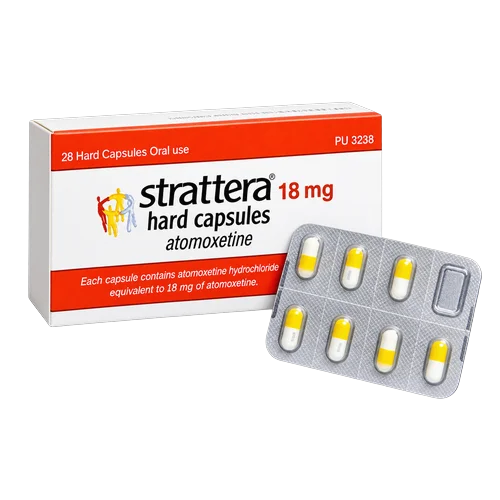
The available product is supplied as hard capsules for oral use. Atomoxetine is prescribed for children, adolescents and adults with an established diagnosis of attention deficit hyperactivity disorder, with age, weight, symptoms and medical history guiding treatment decisions [1].
Atomoxetine as the Active Ingredient
The medicine is taken as a capsule. It is not intended for occasional use before studying, driving or a demanding workday. Regular administration allows the prescriber to judge attention, impulsivity, sleep, appetite and mood over time.
ADHD Treatment Role
Strattera is used as part of an individualised ADHD plan. It does not treat ordinary tiredness, temporary distraction or concentration difficulties caused by poor sleep alone. A clinician considers the full symptom pattern, functional impairment and other possible explanations before choosing treatment.
The goal is practical improvement: completing tasks, waiting before acting, staying organised, controlling interruptions and maintaining attention. A higher strength does not automatically produce better control. The most useful dose is the one that provides sufficient symptom benefit with tolerable adverse effects.
Mechanism of action
Atomoxetine selectively blocks the norepinephrine transporter. This reduces reuptake, leaving more norepinephrine available to signal between nerve cells. A neurotransmitter is a chemical messenger used by nerve cells, while reuptake is the process that clears a messenger from the space between them.
The effect is strongest in brain regions involved in attention and executive function. Atomoxetine also influences dopamine signalling in parts of the brain involved in attention, but it does not produce the same rapid central stimulant effect associated with traditional stimulant ADHD medicines.
Norepinephrine Signalling and Attention
Norepinephrine helps the brain regulate alertness, task focus and responses to competing information. By reducing its reuptake, atomoxetine can improve the consistency of signalling in these networks.
This does not mean that the medicine permanently restores neurotransmitter levels. Its effects depend on continued use, individual biology and the dose selected by the prescriber. The EMA product information describes atomoxetine as a selective noradrenaline reuptake inhibitor rather than a stimulant [2].
How to use it
Atomoxetine treatment is adjusted individually, so how much to use and how often to use it depend on the purpose of treatment and are agreed with a doctor or pharmacist.
Available Capsule Strengths
The prescriber may select a starting strength and adjustment pathway according to age, body weight, response, tolerability, liver function, cardiovascular history and other medicines. Children and adolescents are assessed with weight-based considerations, while adult treatment follows a different clinical framework.
The capsule is intended for oral administration. Do not divide the contents, combine capsules to create a new dose or switch strengths without a prescribed plan.
Dose Administration and Missed Doses
- Take Strattera exactly at the frequency agreed with the prescriber.
- Swallow the capsule whole with water.
- Do not double the next dose after a missed dose.
- If a dose is missed, follow the missed-dose instruction provided by the treating clinician or pharmacist.
- Do not share capsules with another person, even when both people report similar attention symptoms.
- Do not use Strattera as an occasional performance aid.
The capsule should not be opened or emptied into food or drink. Atomoxetine powder can irritate the eyes, and accidental exposure requires prompt rinsing with water and medical advice if irritation persists.
Atomoxetine is not a rapid, as-needed treatment. Some patients notice early changes in attention or impulsivity, while others require longer observation during dose adjustment before the benefit becomes clear.
Sleep, appetite, pulse, blood pressure and mood can change during initiation or dose changes. Recording these changes in a simple daily note gives the prescriber useful information without turning treatment into a complicated project.
Comparison
ADHD treatment categories differ in mechanism, onset pattern and monitoring needs. No single class suits every patient.
| Treatment category | Main mechanism | Practical limitation |
|---|---|---|
| Atomoxetine | Selective norepinephrine reuptake inhibition | Benefit may build gradually; pulse, blood pressure, mood and liver symptoms require attention |
| Stimulant medicines | Increase catecholamine signalling more rapidly | Appetite, sleep, cardiovascular effects and misuse risk require clinical review |
| Behavioural and psychological support | Builds organisation, coping and task-management skills | Requires active participation and may not control core symptoms alone |
Strattera may be considered when a non-stimulant approach is preferred, when stimulant-related problems are a concern, or when a clinician judges that its pharmacology fits the patient’s history. Non-stimulant does not mean risk-free. Atomoxetine can affect cardiovascular measures, sleep, appetite and mood.
Non-Stimulant Treatment Characteristics
Atomoxetine does not function as a short-lived concentration booster. Its intended use is regular treatment of ADHD symptoms across the patient’s daily routine. It also does not create the same pattern of immediate stimulation associated with some stimulant medicines.
The trade-off is that some patients wait longer for a clear response, while others experience nausea, tiredness, insomnia or appetite changes during early treatment. A follow-up appointment helps distinguish temporary adjustment effects from a dose that needs reconsideration.
Common mistakes
Several avoidable errors can make Strattera seem ineffective or poorly tolerated:
- Taking it only on workdays or school days.
- Doubling the next dose after forgetting one.
- Opening capsules and mixing the powder with food.
- Increasing the strength because the first days feel quiet.
- Stopping after a short period without discussing the response.
- Failing to mention albuterol, rasagiline, antidepressants or supplements.
- Using alcohol or recreational substances while new mood or sleep effects are being assessed.
- Ignoring appetite loss, fainting, chest pain, jaundice or suicidal thoughts.
- Sharing capsules with a relative who reports similar ADHD symptoms.
A capsule that feels mild is not necessarily ineffective. Atomoxetine’s benefit should be judged through repeated observations of attention, impulsivity and daily functioning.
Who should not use it
- Current use of a monoamine oxidase inhibitor, or MAO inhibitor.
- Serious cardiovascular disease or uncontrolled high blood pressure.
- Narrow-angle glaucoma.
- Significant liver disease or previous unexplained jaundice.
- A known allergy to atomoxetine or a capsule ingredient.
- A history of severe reaction to atomoxetine.
- Unexplained fainting, palpitations or chest pain.
- Pregnancy or breastfeeding, where the expected benefit and possible risk require individual assessment.
MAO Inhibitor Restrictions
MAO inhibitors can interact dangerously with atomoxetine. Rasagiline is one example that must be disclosed before treatment is started. Other medicines in this group may also matter, so the complete medication list is needed.
Do not stop rasagiline or another prescribed medicine independently to make room for Strattera. The prescriber must manage the sequence of treatment and any required interval between medicines.
When this is not for you
Strattera is not suitable for everyone. Not for you if your prescriber identifies a contraindication, an unsafe interaction or a risk that outweighs the expected benefit.
Liver disease, glaucoma, cardiovascular illness and a history of mood instability may change the risk assessment. Jaundice or unexplained liver symptoms should be treated as a medical warning rather than an ordinary side effect.
Tell the clinician about asthma inhalers, nebulised medicines and rescue treatments. The same applies to decongestants, antidepressants, blood-pressure medicines, recreational substances and supplements that may affect heart rate or blood pressure.
Unwanted effects
The most frequently discussed tolerability problems include nausea, abdominal discomfort, reduced appetite, dry mouth, dizziness, fatigue and sleep disturbance. Insomnia can occur, while some patients report sleepiness instead. The patient information for atomoxetine describes these effects alongside warnings that require medical assessment [3].
| Symptom | Practical response | When to seek review |
|---|---|---|
| Nausea or abdominal discomfort | Taking the capsule with food may help some patients | Persistent vomiting, dehydration or worsening pain |
| Reduced appetite or weight loss | Track meals and weight during dose adjustment | Marked weight loss or difficulty maintaining nutrition |
| Insomnia or fatigue | Record timing, sleep duration and daytime alertness | Persistent sleep disruption or impaired daytime functioning |
| Dry mouth or dizziness | Maintain ordinary fluid intake and rise slowly | Fainting, severe dizziness or recurrent falls |
Taking atomoxetine with food may reduce stomach upset for some people, while food does not remove the need to follow the prescribed schedule. Avoid using sedatives, stimulants or excess caffeine to counter tiredness or insomnia without discussing the combination with the treating clinician.
One practical detail is easy to miss: nausea can be worse when a dose is taken on an empty stomach, yet some patients experience less sleep disturbance when their timing is adjusted by the prescriber. The right timing is individual.
What doctors say
In clinical practice, doctors usually set expectations before the first capsule: atomoxetine is a regular ADHD treatment, not a tablet used only on demanding days. The clinician looks for better functioning across school, work, home responsibilities or relationships, rather than relying on a single day’s concentration.
A useful review asks four questions: Are core ADHD symptoms improving? Is sleep acceptable? Has appetite or weight changed? Are pulse, blood pressure and mood stable? This approach helps separate a genuine response from early stimulation, anxiety or a placebo-like expectation.
Doctors also watch for the misconception that a non-stimulant medicine needs no monitoring. It still requires attention to cardiovascular symptoms, mood changes, liver warning signs and interactions. The NICE ADHD guideline recommends structured follow-up and monitoring during treatment [4].
What customers often ask
What is the best time of day to take Strattera?
The best time depends on whether atomoxetine causes tiredness, insomnia, nausea or other timing-related effects. Some patients take it in the morning, while others use a schedule selected by the prescriber. The EMA product information from 2023 describes once-daily or divided administration as clinical options, with the final schedule based on the individual response. Do not move the timing repeatedly without a treatment plan. A review can help establish a workable routine.
What should happen after a missed Strattera dose?
Do not take two capsules to compensate for a missed dose. Follow the missed-dose plan provided by the prescribing clinician or pharmacist, because the appropriate instruction can depend on the daily schedule. FDA atomoxetine prescribing information from 2022 advises avoiding dose doubling after a missed dose. Record the missed dose if this happens repeatedly, since adherence may need practical support.
How long does one dose of Strattera keep working?
Atomoxetine is intended to provide regular ADHD symptom control rather than a short performance boost. A single dose does not predict the full treatment response, and some patients need continued treatment over time before the benefit can be assessed. The WHO ADHD guidance published in 2023 supports reviewing functioning, adverse effects and adherence across follow-up rather than judging treatment from one day. The prescribed frequency should remain unchanged unless the clinician adjusts it.
Can Strattera be taken with food or on an empty stomach?
Atomoxetine can generally be taken with food or without food, but food may reduce nausea for some patients. Taking it with a meal does not permit extra doses or compensate for a missed dose. The EMA product information dated 2023 supports oral administration with or without food. Keep the chosen routine consistent unless the prescriber recommends a timing change.
How does Strattera differ from the closest alternative by mechanism?
Strattera contains atomoxetine, a selective norepinephrine reuptake inhibitor. Stimulant ADHD medicines act more rapidly on catecholamine signalling and may have different effects on appetite, sleep, pulse, blood pressure and misuse risk. The NICE guideline updated in 2018 describes medication choice as dependent on symptoms, age, comorbidities, response and tolerability. A non-stimulant mechanism does not remove the need for monitoring.
Do you offer anonymous delivery?
Your order will be securely packed and shipped within 24 hours. This is exactly what your package will look like (images of an actual item sent). It has the size and look of a regular private letter (24x11x0.7 cm) and its contents cannot be seen.
Sources
- European Medicines Agency (2023). Strattera: EPAR — Product Information.
- European Medicines Agency (2023). Strattera: Summary of Product Characteristics.
- U.S. Food and Drug Administration (2022). Strattera (atomoxetine hydrochloride) Capsules — Prescribing Information.
- National Institute for Health and Care Excellence (2018). Attention deficit hyperactivity disorder: diagnosis and management, NICE guideline NG87.